
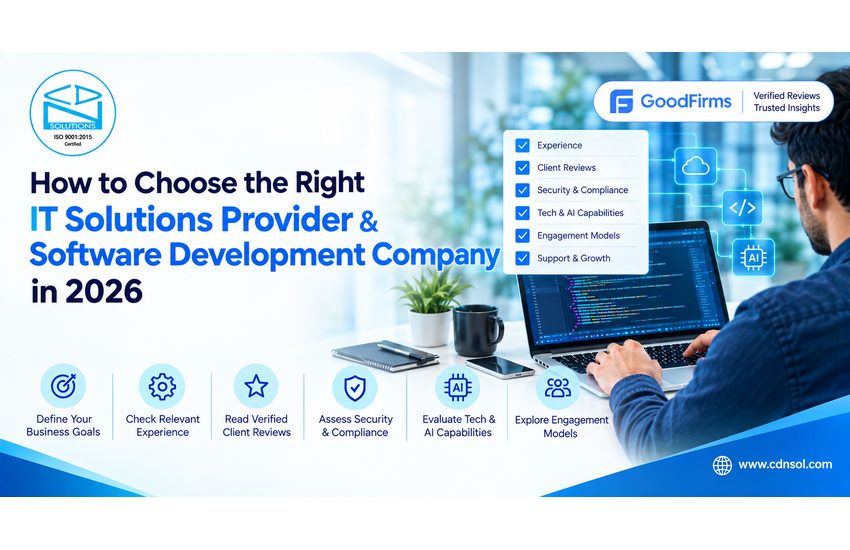
Picking the right IT solutions provider is one of the most important decisions a business makes. The right partner can turn an idea into a product that grows revenue. The wrong one can cost months of time, budget and momentum.
In 2026 the choice is harder than ever. There are thousands of agencies, every website promises “AI-powered” results, and many buyers hire a remote team they will never meet in person. This guide gives you a simple checklist to choose a custom software development company with confidence.
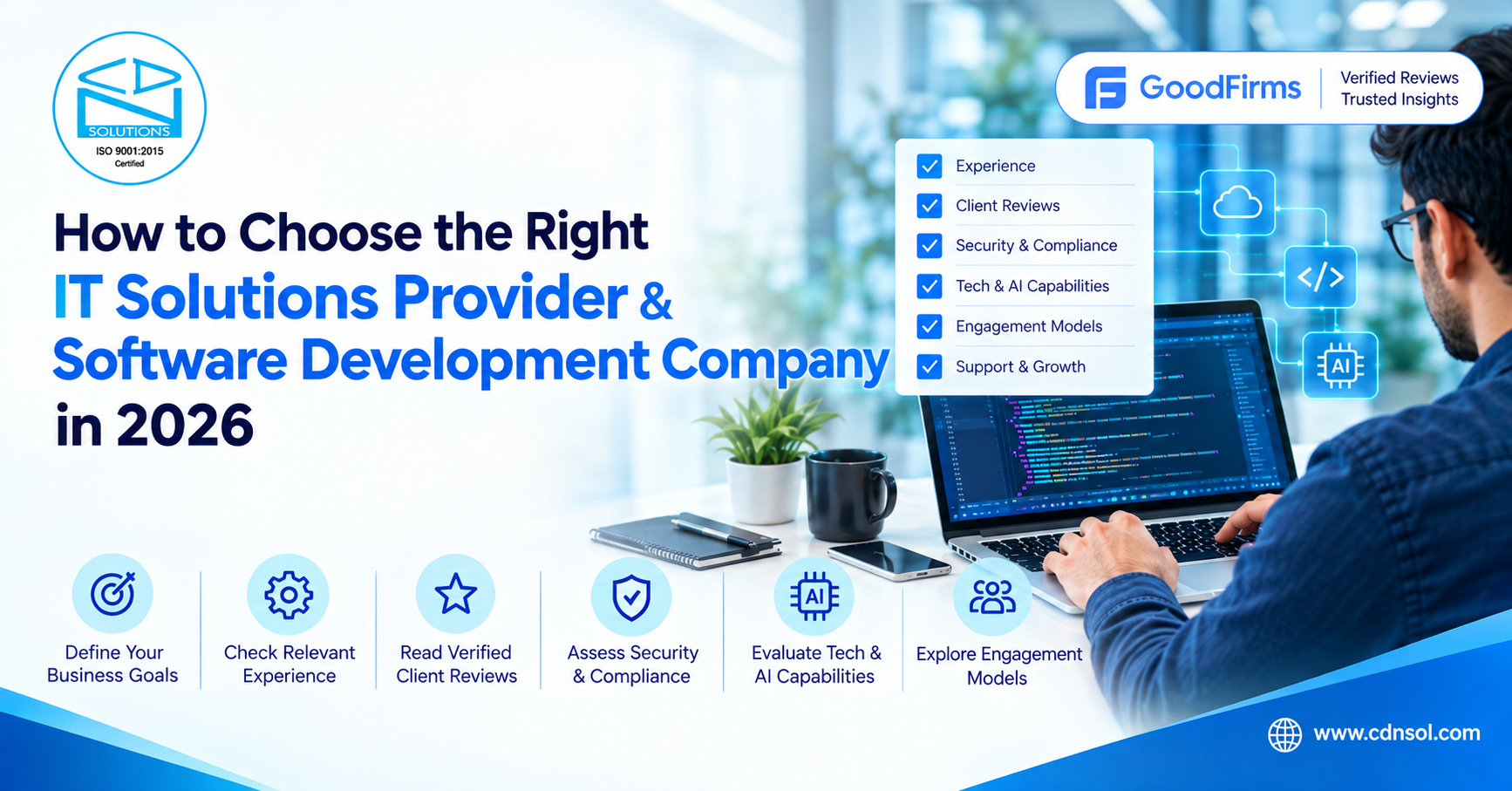
Table of Contents
1. Start with clear business goals
Before you contact any vendor, write down what you want to achieve. Are you building an MVP to test a market, modernizing a legacy system, launching a mobile app, or adding AI to an existing product?
Clear goals help you:
- Shortlist companies that have done similar work
- Compare proposals on the same basis
- Measure success after launch
A good partner will ask about your business outcomes, not only your feature list. If a vendor jumps straight to a price without understanding your goals, treat it as a warning sign. If you are unsure where to start, a short IT consulting session can turn a rough idea into a clear scope.
2. Look for proven, relevant experience
Years in business matter, but relevant experience matters more. Ask every company for case studies in your industry and for projects with a similar tech stack.
Key questions to ask:
- Have you built something similar before? Can we see it?
- Which industries do you know well?
- How long have your core team members worked together?
Industry knowledge saves time and money. A team that already understands pharmaceutical software development, agriculture software development or logistics software development knows the regulations, workflows and users before the first line of code is written.
For example, CDN Solutions Group has offered software development services since 2000. Over 26 years our team has delivered more than 2,200 projects for clients in 75+ countries, with IT solutions for industries such as healthcare, fintech, retail, logistics and manufacturing. That history is useful only because it is backed by case studies buyers can check.
3. Check verified client reviews on trusted platforms
A company’s own website will always show its best side. To get an independent view when choosing an IT provider, look at verified client reviews on B2B review and research platforms.
Platforms like GoodFirms list and review software development companies, IT outsourcing firms and digital agencies worldwide. Buyers can compare firms by services, location, budget and client feedback, which makes it much easier to build a reliable shortlist. You can see how this works on our GoodFirms profile.
When you read reviews, look beyond the star rating:
- Project details: Was the project similar in size and scope to yours?
- Communication: Do clients mention responsiveness and transparency?
- Delivery: Were deadlines and budgets respected?
- Long-term support: Did the relationship continue after launch?
A steady record of detailed, consistent reviews is a far better signal than a handful of perfect scores. Compare what you find on review platforms with the company’s own client testimonials to see if the stories match.
4. Evaluate technical and AI capabilities
Modern products rarely use one technology. Your partner should be comfortable across web, mobile, cloud and, more and more, AI.
In 2026 it is worth asking specifically about:
- AI and machine learning: Do they offer AI ML development services such as LLM integration, AI agents or predictive analytics?
- Cloud and DevOps: Do they provide cloud application development services with CI/CD, containers and scalable architecture?
- Web and mobile: Can they deliver web and mobile app development for iOS, Android and responsive web platforms?
- Proven frameworks: Do they have depth in mature stacks, for example as a Ruby on Rails development company or in .NET?
- Emerging tech: If relevant, do they work as a real blockchain development company or have hands-on IoT experience?
Ask for a short technical discussion with the people who will actually work on your project, not only the sales team.
5. Confirm security, quality and compliance
Your software will handle customer data, payments or business-critical processes, so security cannot be an afterthought.
Check whether the company:
- Holds recognized certifications such as ISO 9001 (quality management) and ISO/IEC 27001 (information security)
- Signs NDAs and has clear IP ownership terms
- Follows GDPR or other regulations that apply to your market
- Has a defined QA and testing process
Certifications do not guarantee success, but they show that a company has documented, audited processes. To dig deeper, see our guide on software development quality.
6. Choose the right engagement model
Different projects need different ways of working. A good partner will explain its engagement models clearly:
- Fixed price: Best for small, well-defined projects
- Time and materials: Flexible for evolving requirements
- Dedicated team / team augmentation: Ideal when you need extra developers who work as an extension of your in-house team
Staff augmentation services are especially useful when you have a product team but lack specific skills or capacity. Learn how IT staff augmentation works and when it beats full outsourcing.
Ask how changes in scope are handled and how often you will see working builds.
7. Assess communication and transparency
Most failed projects fail because of communication, not code. During the sales process, notice how quickly the company responds, how clearly it explains things and whether it is honest about risks.
Good signs include:
- A named project manager and a single point of contact
- Regular demos and progress reports
- Shared tools for tasks, documentation and code
- Overlapping working hours with your time zone
8. Look at value, not just price
The cheapest quote often becomes the most expensive project once rework, delays and missed features are counted. Compare proposals on total value: quality, speed to market, support and long-term scalability.
Ask each vendor what is included after launch, such as bug fixes, maintenance and performance monitoring.
Quick checklist
Before you sign, make sure you can answer “yes” to these questions:
- Do they understand our business goals?
- Have they built similar products, with case studies to prove it?
- Do verified client reviews on independent platforms support their claims?
- Do they have the technical and AI skills our product needs?
- Are their security and quality processes certified and documented?
- Does their engagement model fit our budget and timeline?
- Is their communication clear, fast and honest?
- Is the long-term value worth the price?
For more detail, read how to choose a custom software development company and our checklist on choosing an IT provider.
Conclusion
Choosing a software development company is not about finding the biggest name or the lowest rate. It is about finding a partner whose experience, process and values match your goals. Use independent research, verified reviews and direct conversations to build your shortlist, then choose the team you trust to grow with you.
Looking for reliable custom software development services, mobile apps or AI solutions? Talk to CDN Solutions Group and let’s discuss your next project.